


I never imagined two years ago that I would enjoy being sat in a Radio Four studio trying to explain how much the Government would save from adjusting the triple lock. Mostly because at that point I had never been on the radio. But also because I didn’t expect UK politics to deliver such courage, and, importantly, because it‘s a difficult question to answer.
The Government has told us that they expect this change to reduce the pensions bill by £15 billion after ten years. That looks like a reasonable central case. The Office for Budget Responsibility estimates that on average the triple lock means the State Pension is uprated by 0.53 percentage points a year more than if it was uprated in line with average earnings. So, over ten years that puts the State Pension 5.43 per cent higher than it otherwise would be. Applying that to the total State Pension bill – projected under the triple lock to reach £286 billion in 2039-40 (in cash terms) – shows how you get around £15 billion.
There are several reasons, though, why you shouldn’t simply compare that number to the cost of a National Care Service to decide whether one pays for the other. One is that lower pensions also mean less tax, and so the net saving for the Government is less. Another is that over ten years the value of money (i.e. the impact of inflation) matters a lot.
But I want to focus on a more interesting one.
It depends which decade we are about to have
The central flaw of the triple lock is its unpredictability – the more volatile the economy, the more it costs. So, moving away from it doesn’t just save money, it also stabilises the public finances. But exactly how much we save depends on how volatile the future proves to be. So, if you can tell me whether the next decade will resemble the 90s, 00s, or 10s, I’ll tell you how much we’ll save.
The chart below demonstrates this by examining what the value of the State Pension would have been under different uprating mechanisms in three recent decades. The green line shows uprating in line with average earnings. The blue line represents the original triple lock. The red line is the new ‘adjusted’ triple lock announced this week; under which the pension will rise by the higher of inflation or 2.5 per cent, but will never fall below the value of earnings at introduction (forecast to be 30 per cent).
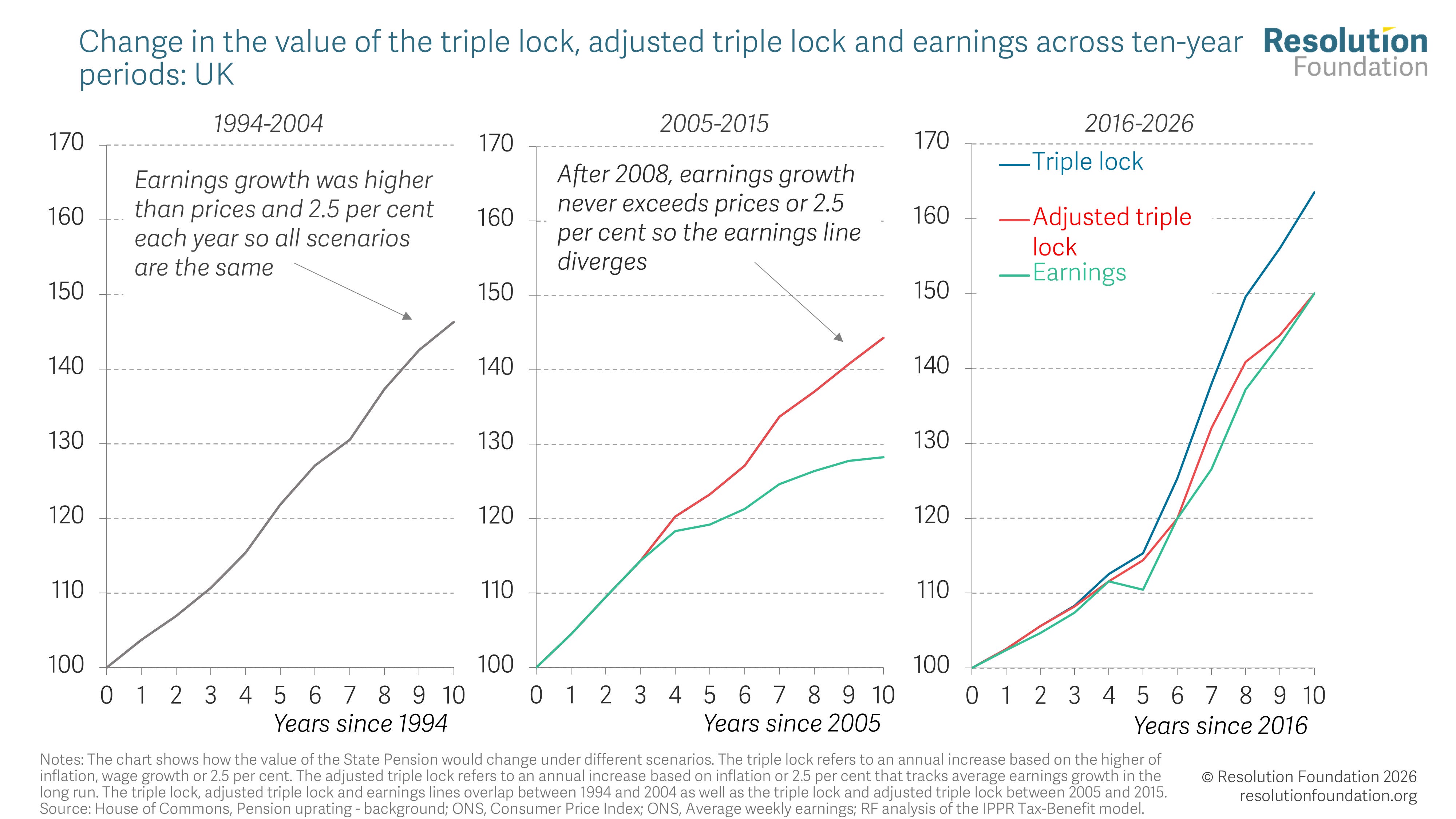
So let me take you back to 1994, the left-hand chart. Pulp Fiction was in cinemas, East 17 and Mariah Carey were battling it out for the Christmas number one and the iconic Nokia 2110 was released. The UK was about to enjoy a decade in which earnings growth exceeded inflation and 2.5 per cent in every year. This makes for great times, and a boring chart. Under all three of the pensions policies we’re considering, the value of the pension ends up the same – which is why we can only see one line. If the next decade looks like this (we can only hope!) then the announcement this week will have saved us nothing. But we’ll be better off in so many other ways that we’ll reminisce fondly about this quaint debate of more volatile times.
Fast forward to 2005, our middle chart. Brokeback Mountain breaks hearts and taboos, James Blunt was a mere world-famous wedding singer rather than a celebrity faithful, and the Resolution Foundation is established just as we entered a decade of shockingly weak living standards, driven by low average earnings growth. Halfway through, new Prime Minister David Cameron introduced the triple lock, at basically the most expensive moment he could possibly have picked, since earnings growth never topped both inflation and 2.5 per cent between 2008 and 2015. Crucially, in this decade of poor earnings growth the ‘adjusted’ triple lock would have been just as costly as its predecessor.
But now we come to the right-hand chart, the decade following 2016. Britain votes Brexit, a global pandemic bites, we all learn the grim reality of ‘supply side shocks’ – and everyone gets invested in their sourdough starters. With earnings and inflation taking turns to top the triple lock, the ratchet mechanism kicks into top gear. Pensioners see the value of their State Pension rise much faster than workers see their pay packets grow. This time, because the rise is caused by volatility, we see the importance of the Burnham’s amended policy. The adjusted triple lock reaches the same value as an earnings uprating over the decade, 8.3 per cent lower than the old triple lock.
So, if the 2030s turns out like one of these three decades then the triple lock would have cost either nothing, £32 billion or £24 billion compared to an earnings uprating (in cash terms). The adjusted triple lock saves most in a volatile world, and so saves nothing in the 90s or 00s, and £24 billion in the 10s. Over the longer term, which will most likely deliver some mixture of all of these economic realities, the new mechanism should trend closer to earnings. If real earnings growth permanently disappoints then even the protections in the new mechanism could prove expensive. A new, if not the main, reason to fight to avoid stagnant wages!
Ruth Curtice is the Chief Executive of the Resolution Foundation. Parth Pandya is a Researcher at the Resolution Foundation.
So this is where Resolution Foundation politics shows it's true colours through economics. So you have no doubt that UK State Pension needs to make savings despite being significantly below pensions in similar economies? No mention of that?
A brief acknowledgement that any savings from keeping the state pension down could be offset by lower income tax being paid by those pensioners - but what about the VAT etc on purchases they won't make. Lower GDP on less spending by them and lower profits and earnings to others because of that lost spending. Have you learned nothing from from 16 years now of seeking savings through 'austerity' - it's a downward spiral. Look at higher tax, higher spending growth economies. It was not government debt that caused the financial crash it was private debt defaults and commercial bank failures which the public purse had to bail out - and we are still being asked to tighten our belts to pay for it while the culprits are back to making mega profits, extracting value, offshoring wherever it is most profitable and moving to wherever has the lowest tax regime.
Any thoughts on how that can be addressed to balance our economy? Or are state pensioners fair game?
The fixation of the Resolution Foundation with the triple lock and the state pension, which I see extends back quite a few years puzzles me. To devote so much time and effort over a potential saving of £15bn over 10 years, a relatively small share of government spending suggests that behind this campaign lies a more far-reaching agenda, especially when previous papers expressed concern that the income of the average retirement household exceeded that of the average working household. Oddly the tenor of the comment was one of concern that pensioner income was too high, rather than working income too low. This suggestion of a race to the bottom doesn’t appear to sit well with the premise that the work of the Resolution Foundation is particularly concerned with the plight of those on low incomes. To put it bluntly a state funded retirement pension that provides sufficient for a reasonable standard of living is the mark of a civilised society and my concern is that the noises from certain quarters suggest that such a basic principle is in the process of being abandoned in favour of the state pension becoming a safety net. It’s commendable that employers are being encouraged to provide pension schemes for their entire workforce, but for the majority of employees and especially for those on lower wages and with broken employment history, these will never be sufficient to provide for a secure retirement. In addition the possibility of members being let down and discovering their funds have disappeared means that the one secure source is a public funded scheme. It’s hardly surprising that the UK is not in step with the rest of Europe in this respect, perhaps because our all powerful financial sector stands to gain most from an expanding private pension regime.