
Wanted: two children
People still want kids, so why is the number of births at a 150-year low? RF's Charlie McCurdy on the material constraints that lie behind the recent British baby bust.

Back when my mum was my age – I’m in my early-30s – she had three kids. I don’t have any yet, and lots of my friends are in the same boat.
I hope you (and my family) don’t mind this personal insight. I say this only because my own experience chimes with one of the biggest changes unfolding across society: the quite extraordinary decline in births. As recently as 2012, births were as high as we’ve seen for several decades with 813,000 babies born in the UK. But in the intervening years births have dropped by around a fifth to just 660,000 in 2024 – effectively a 150-year low (657,000 births were recorded in 2023, marginally fewer ).
This change is huge, and it raises complicated questions for policymakers. Could smaller cohorts of children mean schools having to close? As the population continues to age, will there be enough working people to care for a greying population, and pay the taxes which fund our pensions?
But in researching my new report – Bye bye baby – the thing that really caught my eye was simpler: the growing gap between the children that adults say they would ‘ideally’ like to have and the children they are actually having. When people are asked about their ‘ideal’ family sizes the response is overwhelming around two – a preference which has barely budged over the last 15 years, and holds true across countries including the UK, Germany, France and the Netherlands. When we compare this stated with preference with the reality of the number of births, we find that the baby shortfall in the UK, which averaged only 0.3 births per woman in 2011, had grown to 0.7 by the early 2020s.
The gap between the number of children people say they want, and the number they end up having, has been growing in recent years
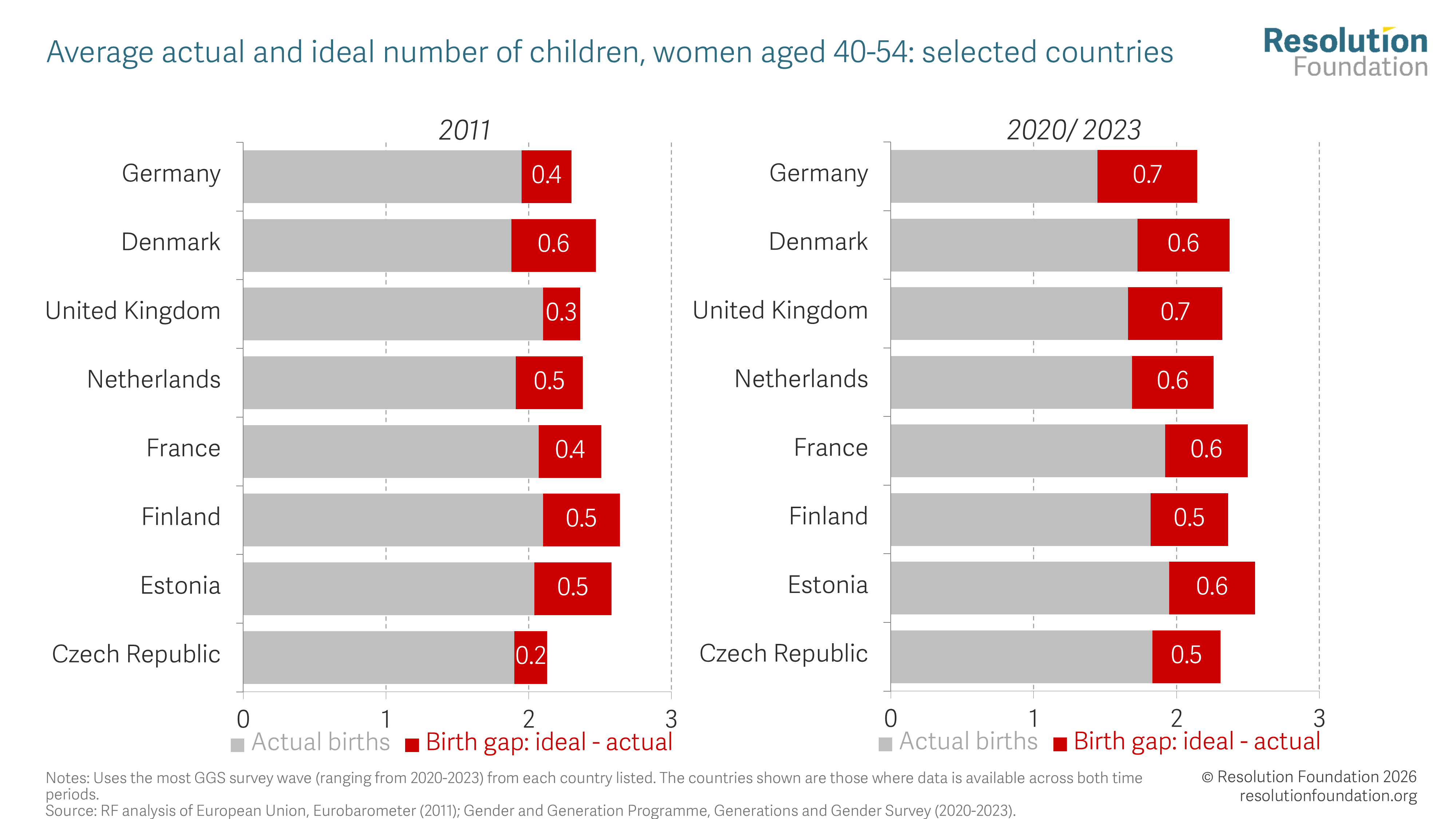
A natural conclusion from this trend might be that the current baby bust is less about personal choice and more to do with constraints.
There have always been a range of reasons why people choose to postpone – or opt out from – having children. That includes not having found the right partner, an active decision to prioritise other life goals like a career or travel, or the simple preference for remaining childfree. Indeed, the decline in births during the 1960s and 1970s followed (among many other factors) rising higher education and employment among women, alongside improved access to contraception and reproductive control. The longer-term story when it comes to family formation has been a shift towards later parenthood led by degree-educated women. In economic terms: as more women built careers, their opportunity cost of having children rose.
Interestingly, such patterns of delay in the past did not lead to fewer children overall. The early Gen Xers eventually caught up with the boomers, they just had children later in life. We won’t know for another 15 years or so whether those millennials born in the late-1980s and early 1990s will catch up with previous generations or remain childless. But this delay has created huge cultural shifts, with being childless at 30 becoming the norm. The share of women in England and Wales who haven’t had a child by 30 has surged from 48 per cent for those born in the late-1980s to 58 per cent for those born in the early 1990s.
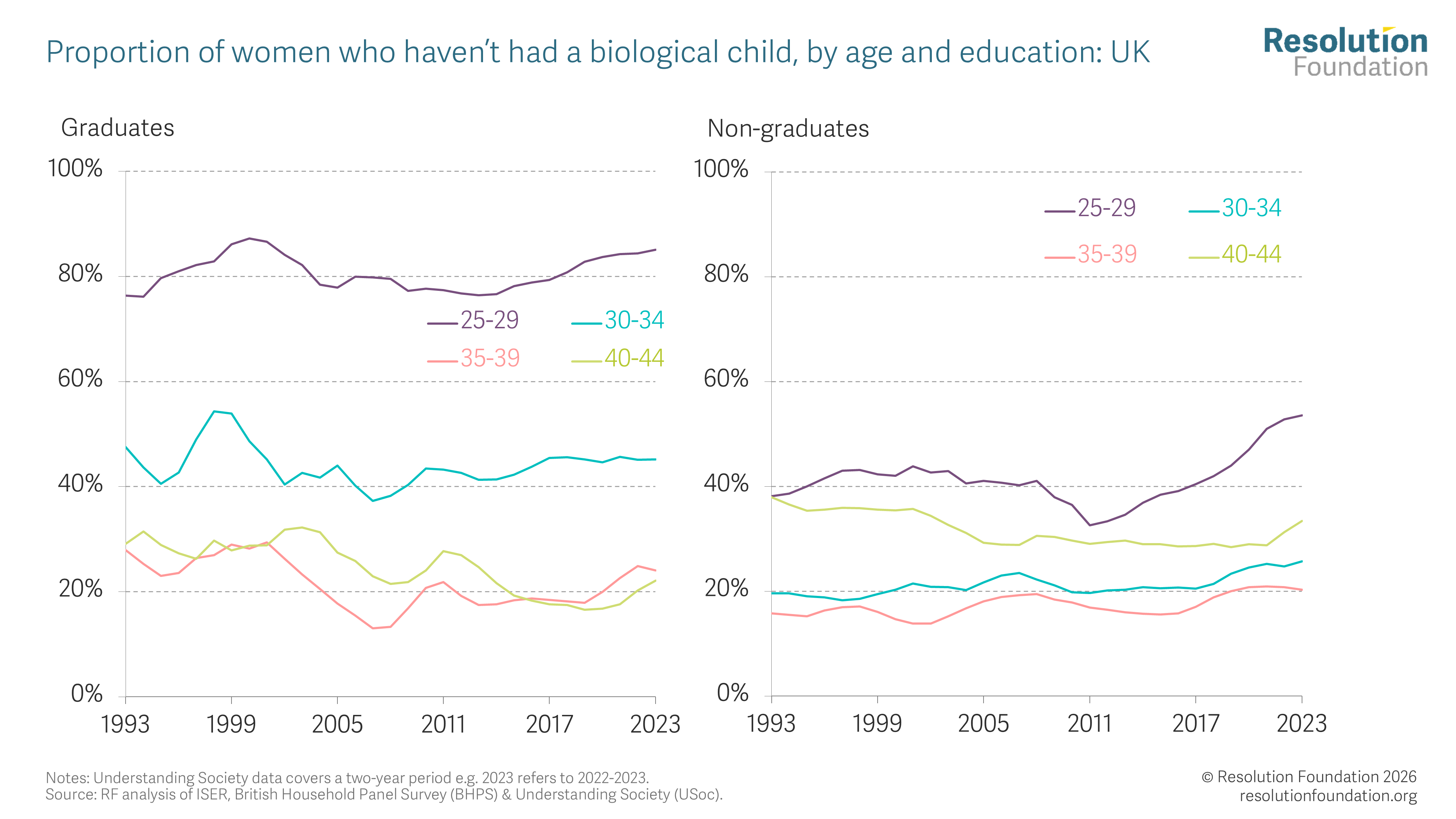
Plus, there are reasons to think that this time around might be different to earlier delays. While it remains true that graduate women are more likely to delay longer than their non-graduate counterparts, this gap has narrowed. Since 2011, the proportion of non-graduate women without children in their late 20s surged from 33 to 54 per cent by 2023.
Graduates set the initial trend for delaying motherhood; now non-graduates seem to be following suit
It’s hardly news that economic constraints have been biting particularly hard on young adults over the last two decades. The well-documented collapse in homebuying among young adults, the resultant switch to the costly private rental sector or ‘living with parents’ is particularly pronounced among non-graduates in their late 20s – it’s roughly doubled since the late 1990s. Living in private rental accommodation (or your childhood bedroom) can be cramped – and the prospect of upsizing to have kids will, for many, feel unaffordable. With roughly nine-in-ten of this group childless, ‘living with parents’ may not just be a tenure category but also a powerful contraceptive.
Where does this leave us? Well, the baby bust is plainly real and important. But if we want to do something about it, we might do better to avoid going down the French route – of writing to 29-year-olds and warning them about the “biological clock”. It doesn’t feel like it’s the role of government to intervene in such personal decisions. Instead, we might want to think about what material action could be taken to enable young adults to live the lives they want – and making housing more affordable seems like the obvious first step.
Charlie McCurdy is a Senior Economist at the Resolution Foundation. Follow him on Bluesky.